SolarEast BESS | Commercial & Industrial Energy Storage Manufacturer
Renewable energy has reached a decisive scale. Combined output from wind and utility-scale solar hit a record 17% of the U.S. electricity mix in 2025 — up from less than 1% two decades ago. In Europe, Germany, the UK, Spain, Italy, and France are rapidly deploying storage to manage the intermittency of their expanding wind and solar fleets. Across Southeast Asia, battery energy storage systems have been placed at the centre of national renewable energy policy in Vietnam, Indonesia, and India.
But scale has amplified an engineering problem that has existed since the first solar panel was installed: renewables generate on nature's schedule, not on demand. Solar produces peak power at midday; demand typically peaks in the evening. Wind output can shift within minutes. The gap between generation and consumption is the fundamental problem Battery Energy Storage Systems exist to solve.
Today, 80% of solar projects operational in the United States are already paired with energy storage — and project activity in 2025–2026 highlights a clear shift toward hybrid solar-plus-storage and wind-plus-storage configurations as the standard deployment model. Storage is no longer optional. It is what makes variable generation commercially viable.
Why Solar and Wind Require Storage
The Solar Timing Mismatch Solar generation peaks at solar noon. C&I demand peaks in late afternoon and evening. The result: maximum generation arrives precisely when demand is lowest, while peak demand arrives after the sun has set. Without storage, surplus midday generation is either curtailed — wasted entirely — or exported at minimal feed-in tariff rates. Evening peak demand, meanwhile, is met from the grid at the highest tariff rates of the day. Battery storage eliminates this mismatch by absorbing surplus midday generation and dispatching it during the evening peak.
The Wind Variability Problem Wind generation can change substantially within minutes. At scale, this rapid variability creates frequency fluctuations and voltage instability that grid operators actively manage. In wind-heavy markets across Northern Europe and Southeast Asia, new wind connections increasingly require demonstration of dispatchable capacity or frequency response capability. BESS satisfies both: it absorbs short-term fluctuations faster than any thermal generation can respond, and it provides committed dispatchable capacity to grid operators.
The Curtailment Economic Loss As renewable penetration rises, grid export capacity constraints are becoming common. Projects without storage face mandatory curtailment — generation paid for through capital investment is simply switched off. BESS converts curtailed generation into stored, dispatchable energy, recovering economic value that would otherwise be entirely lost.
System Architecture: How Integration Works
A solar-plus-storage or wind-plus-storage system comprises four functional layers working in coordination.
Generation Sources Solar inverters convert PV array DC output to AC. In AC-coupled configurations — the most common for C&I and retrofit projects — this AC output feeds a shared bus with the BESS. In DC-coupled configurations, PV DC feeds directly to the battery via a bidirectional DC-DC converter, reducing conversion losses. Wind turbine controllers produce grid-compatible AC output through dedicated power electronics, connecting to the same shared bus.
Battery Energy Storage System (BESS) The BESS stores and releases energy as directed by the EMS. Core components:
Battery Modules — LiFePO₄ cells in standardised rack configurations (280Ah–314Ah cells in 2026 deployments)
Battery Management System (BMS) — Three-tier architecture (cell → module → rack) monitoring voltage, temperature, and state-of-charge at cell level, enforcing protection limits, and reporting to the EMS
Power Conversion System (PCS) — Bidirectional inverter converting between DC battery voltage and AC grid voltage in both charge and discharge directions
Energy Management System (EMS) The EMS is the intelligence layer of the entire system. It continuously monitors generation output, site load consumption, battery state-of-charge, grid tariff schedules, and grid frequency/voltage conditions — then executes dispatch decisions in real time:
Too much generation → charge BESS
Insufficient generation → discharge BESS
Approaching peak tariff period → pre-charge from solar or grid
Grid frequency deviation → instant frequency response
A well-configured EMS is what separates a system that simply stores and releases energy from one that actively optimises across multiple simultaneous value streams.
Grid Connection The grid connection point manages export controls, anti-islanding protection, and — for systems providing grid services — frequency and voltage response interfaces with the network operator.
Integration Scenarios
Solar PV + BESS — The C&I Standard
Solar-plus-storage is the most widely deployed configuration in commercial and industrial markets, for straightforward economic reasons. A well-designed system delivers multiple simultaneous value streams:
Self-Consumption Maximisation — Surplus midday solar is stored and consumed during evening hours rather than exported at low feed-in tariff rates. In European and Southeast Asian C&I markets — where retail electricity prices significantly exceed feed-in tariff rates — this alone delivers compelling project ROI.
Peak Demand Charge Reduction — Many C&I tariffs include a demand charge based on maximum power consumption recorded during the billing period. The EMS monitors consumption continuously and dispatches battery power to prevent demand from reaching peak tariff trigger levels — directly reducing one of the largest line items in commercial electricity bills.
Tariff Arbitrage — In time-of-use pricing markets, the EMS charges the BESS during off-peak low-tariff periods and discharges during peak high-tariff periods, capturing the price differential as net energy cost reduction.
Backup Power — The same battery capacity used for daily energy management provides backup power during grid outages — eliminating the need for a separate dedicated UPS system.
Battery storage economics continue to improve: the Levelised Cost of Storage has declined from USD 150 per MWh in 2020 and is projected to fall below USD 100 per MWh by 2026 — bringing solar-plus-storage within the investment range of a rapidly expanding universe of C&I projects.
Wind + BESS — Grid Compliance and Output Smoothing
Wind-plus-storage integration serves a different primary function: converting highly variable wind generation into a stable, predictable, grid-compliant output.
Output Smoothing — BESS absorbs rapid generation changes and delivers a smoother output profile, reducing voltage fluctuations, improving power quality, and meeting grid operator ramp rate requirements that are increasingly applied to new wind connections.
Frequency Regulation — BESS responds within milliseconds to frequency deviations — a response speed no thermal generation technology can match. As wind displaces thermal generation on grid systems worldwide, fast-response battery storage is becoming essential infrastructure for grid frequency stability.
Dispatchable Renewable Capacity — Combining wind with battery storage allows developers to offer grid operators a product that is commitmentable in advance — transforming wind from an uncontrollable variable source into a partially dispatchable asset rewarded in capacity markets and power purchase agreements.
Solar + Wind + BESS — Hybrid Systems
Hybrid systems combining both generation sources with battery storage achieve the highest utilisation rates and most consistent output. Solar and wind profiles are naturally complementary: solar generates during daylight hours; wind often generates at night and in seasons of lower solar irradiance. Combined, the two sources cover a larger fraction of the 24-hour demand cycle than either can achieve alone. BESS manages remaining gaps and surpluses — delivering dispatchable power whenever neither source is generating.
In emerging economies like India, Vietnam, and Indonesia, government-backed hybrid solar-wind-plus-storage projects are central to rural electrification initiatives and renewable capacity expansion goals — and for remote industrial sites, island communities, and microgrids, the hybrid configuration provides genuine energy independence with diesel generation retained only as emergency
backup.
SolarEast BESS: Integration-Ready for Solar and Wind Projects
SolarEast manufactures LFP BESS systems designed from the ground up for integration with solar PV and wind generation across C&I and utility-scale applications.
C&I Cabinet Series (100kWh – 522kWh per unit) — Modular floor-standing cabinets with integrated BMS, pre-wired for AC coupling with mainstream solar inverters. Multiple units deployable in parallel. CE and IEC 62619 certified. Suitable for commercial and industrial solar-plus-storage from single-building to multi-building campus scale.
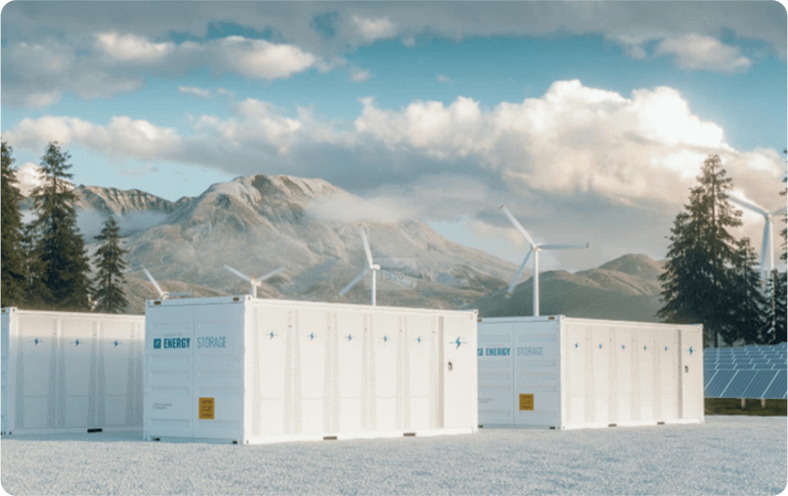
Containerised BESS (1.2MWh – 5MWh+) — Factory-integrated 20-foot ISO container systems with liquid cooling, integrated PCS, and full EMS. TÜV NORD certified. Designed for utility-scale solar co-location, large C&I hybrid systems, and microgrid applications. Factory acceptance tested — commissioning-ready on arrival.
All SolarEast systems include cloud-connected remote monitoring with real-time power flow, state-of-charge, and performance data accessible throughout the system lifetime.