Project Background: Energy Poverty at the Roof of the World
System Architecture: Three Integrated Subsystems
1. Photovoltaic Generation — 40kWp
The off-grid photovoltaic system uses high-efficiency monocrystalline silicon modules configured — a critical design decision unique to heating-dominated applications. Because the dominant load during peak energy scarcity (nighttime, overcast days) , panel orientation was deliberately biased toward maximizing December–February irradiance capture rather than annual average output.
This tilt-angle optimization is a detail many system designers overlook. In Tibet's case, choosing winter-optimal tilt increased cold-season generation by an estimated 15–20% versus an annual-average tilt — directly reducing the risk of battery depletion during consecutive cloudy days.

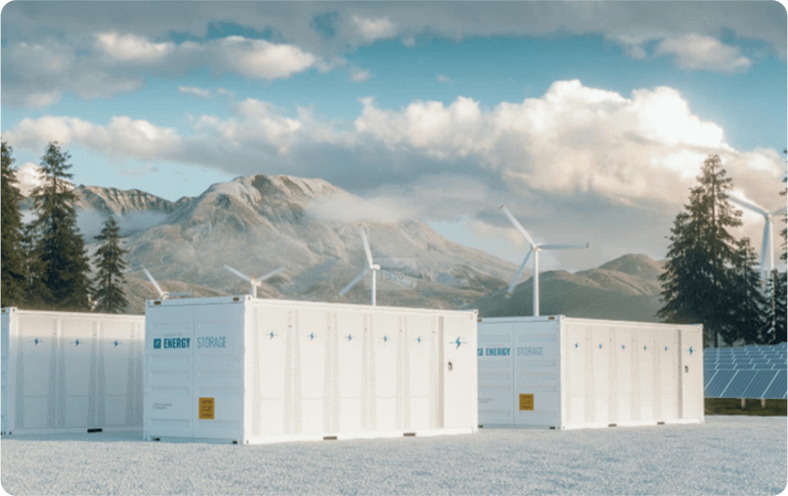
2. Battery Energy Storage — 125kW / 261kWh
Key design parameters:
Chemistry: Lithium Iron Phosphate (LiFePO4 battery) — selected for its superior thermal stability at extreme temperatures, inherent chemical safety, and 6,000+ cycle lifespan
Capacity: 261kWh — sized to cover the gap between 16:00 (sunset) and 11:00 the following morning, the critical window when solar generation is zero or insufficient
Power: 125kW continuous, with headroom above peak impact loads
Grid-Forming PCS: The bidirectional inverter operates in VSG (Virtual Synchronous Generator) mode, which creates a stable AC voltage and frequency reference without any external grid — the defining capability of a true off-grid energy storage system
The 261kWh capacity was not arbitrary. Energy audit data showed:
| Season | Daily Consumption |
| Non-heating season | ~100 kWh/day |
| Heating season (winter) | ~200 kWh/day |

3. Heating Subsystem — Air Source Heat Pump
The system an air source heat pump rather than electric resistance heating — a thermodynamically efficient choice that delivers 3–4 kWh of heat per 1 kWh of electricity consumed (COP 3–4), dramatically reducing the electrical load needed to maintain indoor temperatures above 18°C when outside air is −15°C.
The Core Technical Challenge: Multi-Inverter Off-Grid Synchronization
This is where the Tibet project delivered engineering insights beyond the average system deployment.
Problem 1: Power Imbalance Between Parallel Inverters
When multiple bidirectional PCS units run in parallel in off-grid (islanded) mode, minor power-sharing deviations accumulate over time. Over weeks of operation, individual battery cabinets diverge in state-of-charge — some become overcharged while others are under-utilized. Left uncorrected, this reduces total usable system capacity and accelerates cell degradation.
SolarEast's solution:
A dynamic cabinet SOC balancing algorithm was developed and deployed via firmware update. During discharge, the EMS identifies the lowest-SOC cabinet and temporarily suspends it, forcing load redistribution to fuller cabinets. This continuously equalizes SOC across all units — a function analogous to cell balancing within a battery pack, but applied at the cabinet level.
Problem 2: Circulating Currents in VF-Mode Inverters
In Voltage-Frequency (VF) mode, AC bus circulating currents between inverter outputs caused uncontrolled overcharge at battery string endpoints, triggering protection shutdowns (trip events). This is a well-known challenge in parallel operation that datasheets rarely disclose.
SolarEast's solution:
End-protection threshold margins were widened to accommodate circulating current headroom
A 24-hour baseline load (minimum continuous load) was recommended to prevent inverters running at near-zero output — the operating condition most prone to circulating current instability
Power distribution ratio control was added to the VF-mode firmware, continuously trimming each inverter's output to maintain SOC parity
Intelligent EMS: The Brain of the Off-Grid Microgrid
SolarEast's EMS enables fully automatic operation with no on-site operator required. Functions include:
Real-time monitoring of PV generation, battery SOC, load consumption, and heat pump status
Predictive dispatch: Pre-charges batteries during forecast high-irradiance windows ahead of heating-heavy evenings
Alarm management: Fault detection, remote notification, and automatic protective shutdown
SOC balancing: Dynamic cabinet management as described above
Data logging: Full telemetry for remote diagnostics — critical for a site accessible only by dirt road in winter
The system achieved fully automated unattended operation from commissioning — a key requirement for any remote off-grid power system serving government infrastructure with no local technical staff.

Why This Project Matters for Global Off-Grid Buyers
The Tibet township installation is a technical reference point for several buyer segments actively searching for solutions:
Remote government & public infrastructure — Schools, clinics, border posts, and municipal buildings in regions without grid access face identical challenges. This project demonstrates that commercial-grade off-grid BESS can operate reliably at government service levels without resident technicians.
High-altitude deployments — Mining operations, telecom towers, and research stations at elevation face the same LFP chemistry advantage: stable electrochemistry at temperatures where NMC batteries lose 30–40% capacity.
Cold-climate integrated heating — The system design principle — pairing PV + BESS with a heat pump rather than resistance heating — cuts energy storage requirements roughly in half versus pure electric heating. This directly reduces system cost and battery sizing for any system project.
Related Solutions
Commercial & Industrial Solutions
+ -Utility-Scale Solutions
+ -Residential Solutions
+ -