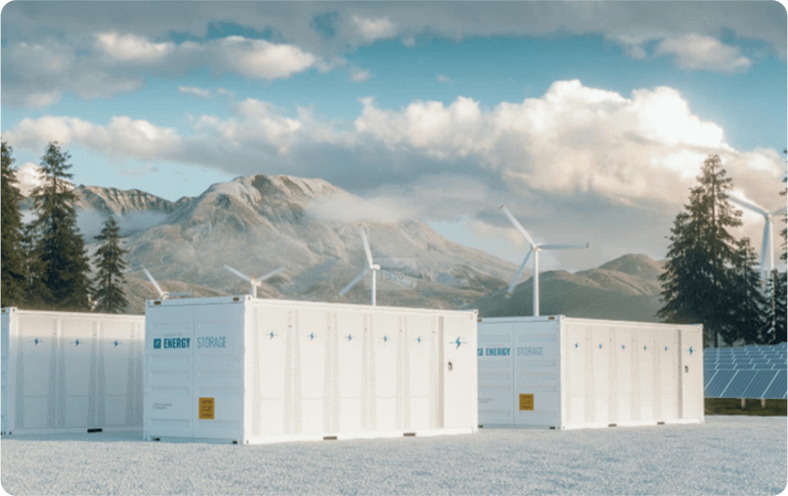
For most homeowners and small commercial solar systems today, the best battery type for solar storage is lithium iron phosphate (LFP) due to its long lifespan, high efficiency, strong safety profile, and competitive cost per kWh over its lifetime. Other battery chemistries—such as NMC lithium-ion, lead-acid, and saltwater batteries—still serve specific use cases, but LFP remains the most balanced and future-proof option for solar energy storage.

Why Battery Type Matters in Solar Storage
Choosing the right battery for a solar system isn’t just about capacity or price. Battery chemistry influences:
● Round-trip efficiency (how much energy is actually usable)
● Cycle life (how long the battery lasts)
● Safety (thermal stability and risk of overheating)
● Depth of discharge (DoD)
● Cost over the battery's lifetime
With solar adoption increasing globally, understanding the pros and cons of each battery type is essential—especially as homeowners and installers search for durable and cost-effective solutions.
1. Lithium-Ion Batteries (LFP vs. NMC)
Lithium-ion batteries dominate modern solar storage, but two chemistries stand out:
● Lithium Iron Phosphate (LFP)
● Lithium Nickel Manganese Cobalt (NMC)
Both are used in residential and commercial energy storage systems, though they have different strengths.
1.1 Lithium Iron Phosphate (LFP): The Market Leader for Home Solar
LFP batteries are widely considered the best battery type for solar storage today.
Key advantages
● Long lifespan: Industry studies (including DOE and BNEF data) show LFP routinely achieves 6,000–10,000 cycles, far outperforming legacy chemistries.
● Higher safety: LFP is chemically stable and less prone to thermal runaway than NMC.
● High depth of discharge: Up to 90–95% usable capacity.
● Excellent cost per cycle: Although the upfront price can be similar to NMC, LFP lasts longer.
● Environmentally friendlier: No cobalt content.
Best for
✔ Whole-house solar backup
✔ Daily cycling (self-consumption)
✔ Off-grid cabins or hybrid solar systems
✔ Installations requiring high safety margins
This is why leading global storage suppliers—including Solareast BESS—use LFP across most residential, C&I, and utility-scale systems.
1.2 NMC (Nickel Manganese Cobalt): High Energy Density
NMC batteries are widely used in electric vehicles due to their higher energy density, meaning they store more energy in a smaller footprint.
Advantages
● Compact size
● High power output capability
Limitations
● Shorter lifespan than LFP (typically 3,000–5,000 cycles)
● Can be more sensitive to overheating
● Contains cobalt, which raises cost and sustainability concerns
Best for
✔ Space-limited installations
✔ High-power performance needs
Industry guides (including the EcoFlow article) note these differences clearly, but for most solar applications, NMC is becoming less favored due to safety and longevity considerations.
2. Lead-Acid Batteries (Flooded, AGM, Gel)
Before lithium-ion batteries became affordable, lead-acid batteries dominated off-grid solar systems. Today, they remain a budget option but come with major trade-offs.
Advantages
● Low upfront cost
● Familiar technology
● Easy recycling (existing global infrastructure)
Limitations
● Short lifespan (500–1,500 cycles)
● Lower DoD (50% typical)
● Heavy and bulky
● Requires ventilation (flooded cells emit gas during charging)
Best for
✔ Very small or temporary systems
✔ Low-budget off-grid projects
For whole-house solar, lead-acid rarely makes economic sense long-term.
3. Saltwater Batteries (Sodium-Ion / Aqueous)
Saltwater batteries—highlighted in many sustainability-focused reports—offer an alternative without heavy metals.
Advantages
● Non-toxic materials
● Good thermal safety
● Environmentally friendly disposal
Limitations
● Lower energy density
● Higher cost
● Limited commercial availability
● Shorter track record for real-world performance
Best for
✔ Eco-focused buyers
✔ Sensitive environments (schools, hospitals)
However, sodium-ion technology is evolving quickly. It may become a strong competitor in the mid-term, especially as manufacturers aim to reduce lithium dependency.
4.Flow Batteries
Flow batteries (such as vanadium redox systems) store energy in liquid electrolytes and excel in long-duration applications.
Advantages
● Extremely long cycle life
● 100% depth of discharge
● Great for long-duration storage (6–12+ hours)
Limitations
● High upfront cost
● Requires a large installation space
● Not practical for typical homes
Best for
✔ Utility-scale storage
✔ Large commercial solar
✔ Applications requiring deep daily cycling
Flow batteries are powerful, but still far from becoming mainstream for home solar applications.
What Is the Best Battery Type for Solar Storage?
Based on today’s technology, field performance, and global adoption trends:
→ Lithium Iron Phosphate (LFP) is the best battery type for solar storage for most homes.
Why?
● Longest lifespan
● Safest chemistry
● Strong cost-effectiveness
● High DoD and high efficiency
● Low maintenance
● Stable supply chain
This aligns with industry consensus, including evaluations from independent energy labs, EcoFlow’s solar battery guide, and market data from BNEF and IEA storage outlooks.
5.SolarEast: Your One-Stop Source for LFP Solar Storage Solutions
As the global market shifts toward LFP, Solareast BESS provides advanced, fully integrated LFP solar battery backup systems designed for:
● Home solar self-consumption
● Whole-house backup
● Off-grid and hybrid solar applications
● C&I and utility storage
Why homeowners and installers choose Solareast:
→ High-cycle LFP technology for long life
→ Modular & scalable designs
→ Smart BMS + EMS controls
→ Safe, certified, globally compliant systems
→ End-to-end engineering + technical support
Whether you are a distributor, installer, or solar EPC, Solareast offers customizable solutions to meet diverse residential and commercial requirements.
Conclusion
While multiple battery types serve different segments of the energy storage market, LFP remains the best battery type for solar storage for most homes today. Its unmatched balance of safety, longevity, cost-effectiveness, and performance makes it the clear choice for solar-powered living.
If you have any energy storage needs, please contact our professional engineers. We will provide you with the most cost-effective energy storage solutions.